
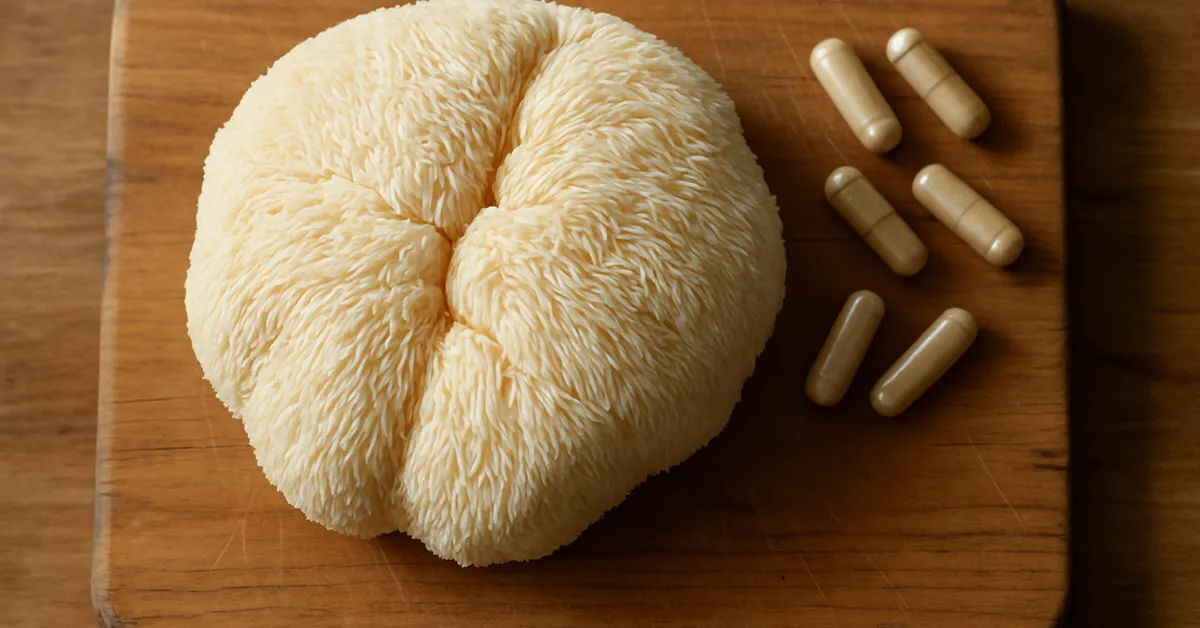
The Biology Behind Lion’s Mane and Brain Health
Lion’s mane mushroom (Hericium erinaceus) contains two classes of compounds found nowhere else in nature: hericenones and erinacines. Both are capable of crossing the blood-brain barrier, and both stimulate the production of nerve growth factor (NGF), a protein that regulates the maintenance, survival, and regeneration of neurons. NGF is critical for the health of cholinergic neurons in the basal forebrain, the same neurons that deteriorate in Alzheimer’s disease and age-related cognitive decline.
Disclosure: This post contains affiliate links. We may earn a commission if you purchase through our links, at no extra cost to you. We only recommend products we trust.
Hericenones are found in the fruiting body of the mushroom and are relatively small molecules that cross the blood-brain barrier readily. Erinacines are found in the mycelium and are even more potent NGF stimulators in animal studies. Both work by stimulating NGF synthesis rather than acting as NGF itself, which means the brain’s own neurons are prompted to produce more of a protein they already use for maintenance and repair. This is a fundamentally different mechanism from most cognitive supplements, which typically work on neurotransmitter levels rather than underlying neuronal health.
The NGF stimulation pathway also has downstream effects on myelination. NGF promotes the activity of Schwann cells and oligodendrocytes, which produce the myelin sheath around nerve fibers. Better myelination translates to faster signal transmission between neurons, which has implications for processing speed and working memory capacity alongside the more commonly discussed benefits for neuronal survival.
What Human Trials Show for Memory and Cognitive Function
The landmark trial in this space was published in 2009 and enrolled 50 adults aged 50-80 with mild cognitive impairment. Participants received either 250mg of Hericium erinaceus powder three times daily (750mg total) or placebo for 16 weeks. The lion’s mane group showed significantly higher scores on the Hasegawa Dementia Scale, a standard assessment of cognitive function. Effects began appearing around week 8 and continued through week 16. Critically, scores returned toward baseline four weeks after stopping supplementation, suggesting the benefit requires sustained intake (PMID: 19861415).
A 2020 randomized trial examined lion’s mane effects in healthy adults, finding improvements in cognitive test performance and reduced subjective feelings of anxiety and irritability compared to placebo. A more recent 2023 trial studied healthy young adults and found that lion’s mane consumption improved performance on tasks measuring processing speed and working memory within 60 minutes of intake, suggesting both acute and long-term mechanisms may be at play (PMID: 36413553).
Research on mild cognitive impairment has been the most rigorous testing ground. A 2019 study evaluated the effects of lion’s mane extract supplementation on subjects with mild cognitive impairment and found significant cognitive improvements compared to placebo, along with favorable changes in blood biomarkers associated with neuroplasticity (PMID: 31413233). A 2023 systematic review of the available evidence concluded that while more large-scale trials are needed, the current evidence supports lion’s mane as a promising intervention for cognitive function, particularly in populations showing early cognitive decline (PMID: 23735479).
The Mild Cognitive Impairment Research
Mild cognitive impairment (MCI) occupies the space between normal aging and dementia. People with MCI experience more memory lapses and cognitive difficulties than expected for their age, but these don’t yet interfere significantly with daily life. MCI is often a precursor to Alzheimer’s disease, though not inevitably so. It’s also the population where lion’s mane has the strongest human trial evidence.
The reason MCI research is particularly compelling is that it targets people with measurable NGF deficits and early cholinergic neuronal degradation. Since lion’s mane works by stimulating NGF synthesis, it may be most effective precisely in people whose NGF production is starting to decline. This isn’t a claim that lion’s mane prevents Alzheimer’s; the evidence doesn’t support that conclusion. But the mechanism aligns with the pathology, and the trial outcomes in MCI populations are the strongest signal in the literature.
For healthy adults without MCI, the benefits are more modest and primarily described as improvements in processing speed, focus, and subjective mental clarity rather than dramatic memory enhancement. The article on lion’s mane for ADHD and focus covers the cognitive clarity mechanisms in more detail for people interested in that angle.
Realistic Expectations vs Hype
Lion’s mane is not a nootropic that produces dramatic effects the week you start taking it. The NGF stimulation mechanism requires time: NGF synthesis increases, neurons respond by growing and maintaining their structure, and functional improvements emerge over weeks to months. The 16-week trial showing cognitive improvements in MCI patients is the realistic timeline, not 3 days.
The supplement market has overclaimed on lion’s mane significantly. Claims like “grow new brain cells” and “reverse Alzheimer’s” are not supported by the human evidence. What the evidence does support: sustained supplementation appears to protect and potentially improve cognitive function in older adults, may benefit people with early cognitive decline, and shows promising effects on processing speed and working memory in healthy younger adults. That’s meaningful, but it’s also not magic.
Quality matters here more than in many supplement categories. Lion’s mane is commonly sold as either fruiting body or mycelium, and the distinction matters for which active compounds you’re getting. Fruiting body products concentrate hericenones; mycelium products concentrate erinacines. Both have supporting research. Products standardized to beta-glucan content give you a way to compare potency across brands.
Who Benefits Most From Lion’s Mane for Memory
The evidence most strongly supports use in adults over 50 showing early signs of cognitive decline, people with family history of dementia who want to support brain health preventively, and adults dealing with brain fog, poor focus, or cognitive fatigue related to stress or poor sleep. The safety profile is excellent, with no serious adverse effects reported in the available trials, making it a reasonable addition for most adults interested in long-term brain health.
Younger adults may experience benefits primarily in the focus and processing speed domains rather than memory protection specifically. If you’re 25 and taking lion’s mane primarily for sharper focus and faster thinking, the evidence supports that use but the effect sizes are generally more modest than in older adults with MCI.
People experiencing cognitive symptoms related to anxiety or depression may also benefit. Some trial data shows reductions in anxiety and irritability alongside cognitive improvements, which makes mechanistic sense given NGF’s role in hippocampal neurogenesis and the relationship between stress, neuroplasticity, and working memory. The article on lion’s mane safety considerations covers populations where caution is warranted.
Dosage for Cognitive Effects
The 16-week landmark trial used 750mg of whole mushroom powder per day (250mg three times daily). More recent trials have used extract forms, typically 500mg to 1,000mg of standardized extract per day. Extracts are more potent per gram because they concentrate the active compounds, so a 500mg extract dose is not equivalent to 500mg of whole powder.
For practical supplementation, look for products providing 500-1,000mg of fruiting body extract per day, standardized to at least 25-30% beta-glucans. The lion’s mane mushroom complex from Me First Living combines lion’s mane with complementary functional mushrooms at research-supported doses. Available direct from Me First Living or on Amazon.
Consistency is more important than timing. Taking lion’s mane daily at whatever time fits your routine is more important than optimizing the exact hour. Some people take it with morning coffee or breakfast; others prefer evening dosing. There’s no compelling pharmacological reason to prefer one over the other for the NGF synthesis pathway, since the mechanism is about sustained compound availability rather than acute peaks.
What to Take Away
The research on lion’s mane for memory and cognitive decline is more substantive than most brain supplement categories. The mechanism is well-characterized, human trials exist, and the populations most likely to benefit are identifiable. For adults over 50 concerned about cognitive aging, people with early signs of memory decline, and anyone looking for evidence-based brain health support, lion’s mane is one of the more defensible choices in the supplement aisle. Expect results over months rather than weeks, use a quality fruiting body extract at adequate doses, and approach it as long-term brain maintenance rather than a quick cognitive boost.